Research
Gauge theory and low-dimensional topology
My research focuses on extracting topological consequences for three- and four-dimensional manifolds, knots, and spatial graphs from solutions gauge-theoretic equations like the Yang-Mills and Seiberg-Witten equations.
Gauge theory
Gauge theory has provided nonlinear partial differential equations that have surprising application to topology. Solutions to the Yang-Mills, Seiberg-Witten, and related equations form moduli spaces whose geometry and topology encodes global information about the underlying manifold.
Floer homology
Floer theory is subtle infinite dimensional generalization of homological invariants that captures "middle dimensional" homology of infinte dimensional manifolds. My work focuses on the Instanton and monopole versions of Floer homology. This has lead to applications to the topology of three-manifolds, including questions about fundamental groups, foliations, and Dehn surgery.
Knots, webs, and foams
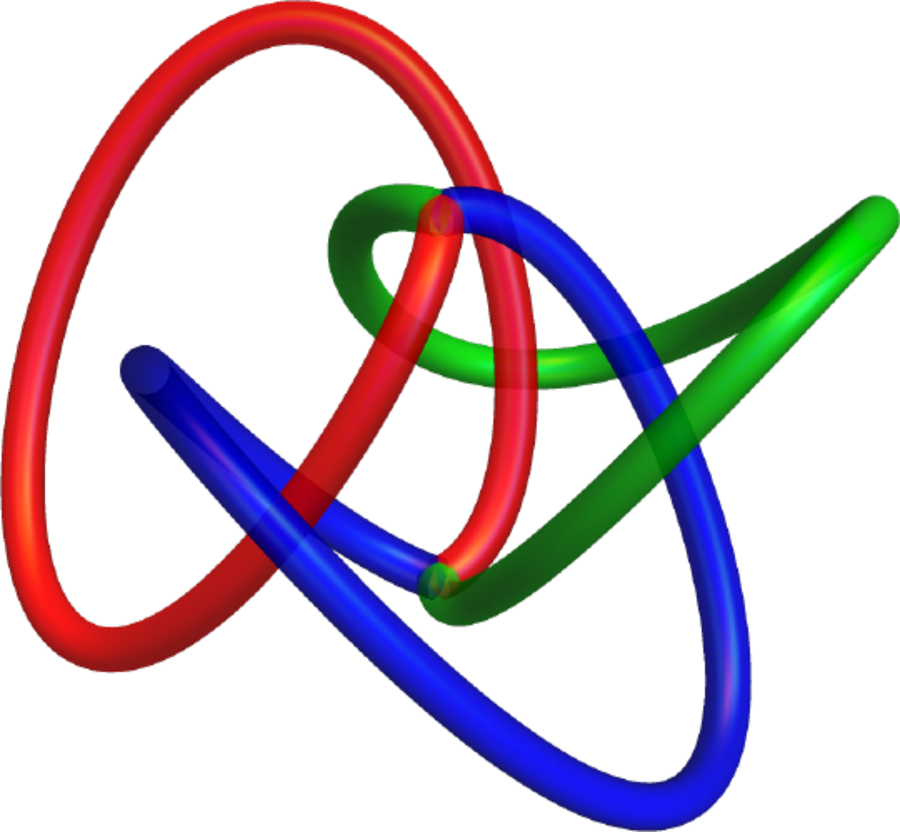
Gauge-theoretic invariants of knots and spatial graphs interact with Khovanov homology, Bar-Natan homology, concordance invariants, and graph colorings. This circle of ideas includes the proof that Khovanov homology detects the unknot and connections to the 4-color map theorem. One current project focuses on the higher rank case, so an SU(N) instanton homology for webs and foams.
Four-manifolds and embedded surfaces
Four-dimensional topology exhibits smooth phenomena with no counterpart in other dimensions. Gauge theory detects exotic smooth structures, constrains embedded surfaces, and relates the differential topology of four-manifolds to algebraic and symplectic geometry.