Writing Beamer Presentations (for the youngest ones)
A Beamer presentation is still rigorous mathematics, but not as rigorous as that of a paper. Its purpose is to reach your audience with your research, so it is written in a much less formal style, and many rules that apply to papers do not apply to slides, and the other way around. Beamer presentations take more time to prepare than a blackboard talk, but they are easier to give. This page collects the advice I give to the students who prepare a talk under my supervision, including the tips I give for the Fall-Term MIT PRIMES Conference.
The Mistakes You Should Avoid
Here is a list containing some of the mistakes I often notice in the first slides and the first practice runs of young researchers, with pointers to people who have written about each of them at length.
Know Your Audience
- Talking to the experts. Your main audience is that consisting of your peers, not the mathematicians who will read your paper. Think of your listener as yourself before your project started, when your mentor had not yet taught you all the mathematics behind it. Your peers want two things from your talk: to learn some new and cool mathematics, and to find out what you have been working on. (Tao, Talks are not the same as papers; Bourne, Ten simple rules for making good oral presentations, Rule 1.)
- Slides written like a paper. The style of your slides should be much friendlier than the style of your paper. Material copied from your paper must be rewritten before it goes on a slide. (Tao, Talks are not the same as papers; Higham, Handbook of Writing for the Mathematical Sciences, Chapter 12.)
- A talk that is not self-contained. Introduce every concept you need, in particular every concept that appears in the statements of your main results, and do not assume that your listeners know the background you learned during your project. (Tantau, Wright, and Miletić, The beamer class, Section 5.1.2; Halmos, How to talk mathematics.)
- A definition with no example. Your listeners do not master a concept just because you stated its definition. Follow every important definition, and as many results as you can, with a simple example or a picture. (Tao, Talks are not the same as papers; Halmos, How to talk mathematics.)
What to Present
- Starting with your first definition. Begin with a short introduction: what the question is and why it is interesting. (Tantau, Wright, and Miletić, The beamer class, Section 5.1.2; Halmos, How to talk mathematics.)
- Technical proofs. Proving your results is probably what you enjoyed most in your project, but your listeners do not need the technical details to appreciate what you found. They value enlightening examples much more than proofs. Include a proof only if it is short, not technical, and teaches something. (Tao, Talks are not the same as papers; Higham, Handbook of Writing for the Mathematical Sciences, Chapter 12.)
- Too many results. It is better to leave some results out, slow down, and add examples than to rush through every theorem you proved. A talk should make one main point. (Rota, Ten lessons I wish I had been taught; Tantau, Wright, and Miletić, The beamer class, Section 5.1.1.)
- Too many slides. A simple rule is at most one slide per minute. (Tantau, Wright, and Miletić, The beamer class, Section 5.1.1.)
Writing the Slides
- An incomplete first slide. The title slide should contain the title of your talk, the names of all the authors (ordered alphabetically by last name), the name of your mentor, the name of the conference, and the date of your talk. (Tantau, Wright, and Miletić, The beamer class, Section 10.)
- Defined terms in italics. Italics are hard to spot on a screen. Highlight every term you define with
\alert(or bold) instead of\emph. (Tantau, Wright, and Miletić, The beamer class, Section 5.1.3.) - Empty words. Drop sentences like “We proceed to discuss this example in more detail.” A slide should contain the important words and formulas, not paragraphs. (Tantau, Wright, and Miletić, The beamer class, Section 5.1.3; Bourne, Ten simple rules for making good oral presentations, Rule 2.)
- A smaller font to make it fit. If the content does not fit on a slide, split the slide or cut the content. (Tantau, Wright, and Miletić, The beamer class, Section 5.1.3.)
- Citations like “[3, Theorem 2]”. Your listeners cannot jump to the last slide while you are talking, but you still have to give credit. Instead of “According to [3, Theorem 2], at any time \(t\) in Azkaban, for each prisoner \(p\) there exists a dementor \(d\) near \(p\)”, write “At any time \(t\) in Azkaban, for each prisoner \(p\) there exists a dementor \(d\) near \(p\) (S. Black, 1997)”. Label your own results in the same way, for instance “Theorem (PRIMES 2026)”. (Tantau, Wright, and Miletić, The beamer class, Section 5.1.2.)
- Definitions that are gone when you need them. Your listeners cannot turn back to an earlier slide. Recall a definition or a piece of notation when you use it again. (Tao, Talks are not the same as papers.)
- Forgetting how to write mathematics. Slides are less formal than a paper, but the basic rules still hold: do not start a sentence with a symbol, use words correctly, and proofread every slide. (Knuth, Larrabee, and Roberts, Mathematical Writing; see also Writing Mathematics Properly.)
Giving the Talk
- Reading your slides. Your audience reads your slides faster than you can read them aloud. Talk around them and add something that is not written there. (Higham, Handbook of Writing for the Mathematical Sciences, Chapter 12; Bourne, Ten simple rules for making good oral presentations, Rule 1.)
- Rushing. Speak clearly, and pause briefly after each important definition, example, and main theorem so that your listeners have time to digest it. (Rota, Ten lessons I wish I had been taught; Higham, Handbook of Writing for the Mathematical Sciences, Chapter 13.)
- Not practicing enough. It is normal to feel nervous, but you will feel much more comfortable once you have practiced your talk several times: you will be thinking about your audience instead of about what comes next. Even the most experienced mathematicians practice an important talk. (Bourne, Ten simple rules for making good oral presentations, Rule 7; Higham, Handbook of Writing for the Mathematical Sciences, Chapter 13.)
- Running over time. Time your practice runs, and if the talk is too long, cut material instead of speaking faster. (Rota, Ten lessons I wish I had been taught; Tao, Talks are not the same as papers.)
The Last Slides
- No acknowledgments. Thanking the people who helped you is an important habit. End with a slide that thanks your mentor, anyone who contributed to the work you are presenting, and the program that gave you this research opportunity, such as MIT PRIMES, the CrowdMath Internship, or UROP. (Bourne, Ten simple rules for making good oral presentations, Rule 10.)
- The whole bibliography of your paper. Include a slide with only the main references of your talk. It is useful to the people who read your slides after they are posted online. (Tantau, Wright, and Miletić, The beamer class, Section 5.1.2.)
- Posting the slides with all the pauses. For the version you share or post, write
\documentclass[trans]{beamer}: thetransoption ignores\pauseand makes the slides easier to read. (Tantau, Wright, and Miletić, The beamer class, Section 20.)
Before Your Practice Run
- Start preparing your slides at least two weeks before your talk.
- Bring a pre-final version to your practice run: a complete presentation with the same slides, examples, and results as the one you will give.
- Practice several times before the practice run (together, if you present with someone else), and write down how long your last practice took.
- Send me your pre-final slides the day before the practice run.
A Sample Beamer Presentation
To see these rules at work, look at the following short presentation by three young researchers you may know: Hermione Granger, Harry Potter, and Ronald Weasley, mentored by Prof. Remus Lupin in the Gryffindor Program at Hogwarts. The magic is fictional, but the mathematics is real: it is a first look at factorization theory through the numerical monoid generated by \(6\), \(9\), and \(20\).
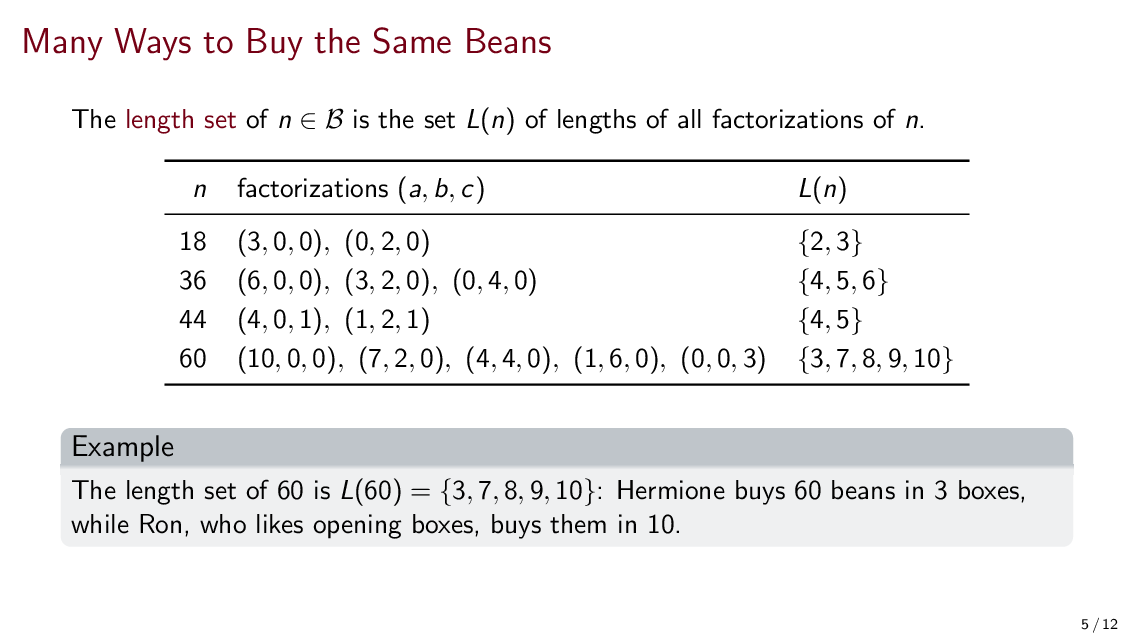
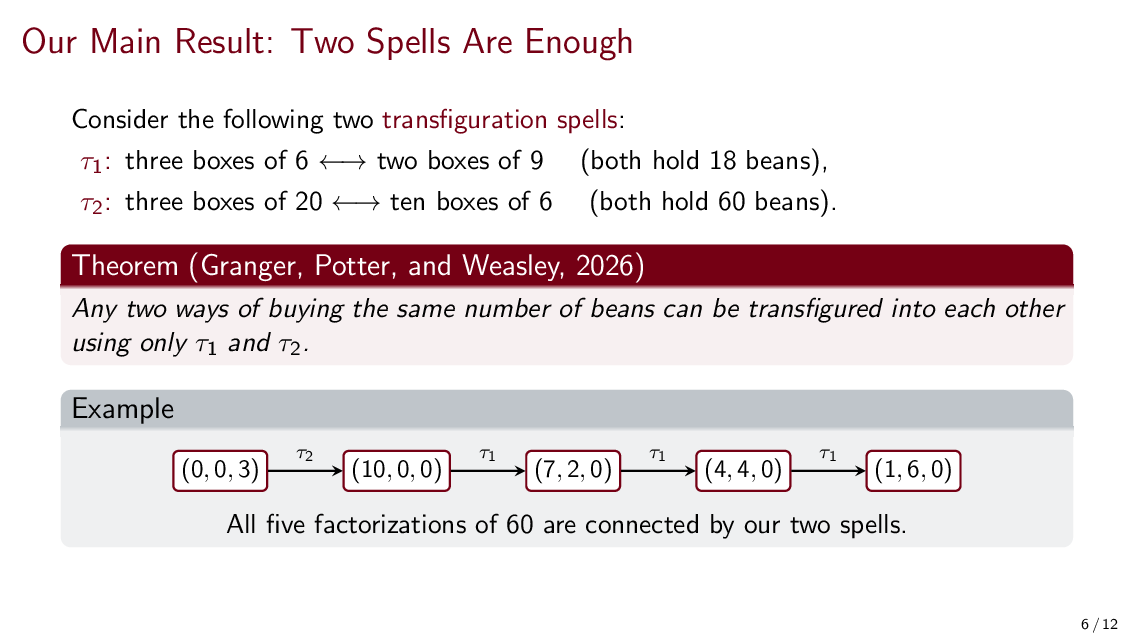
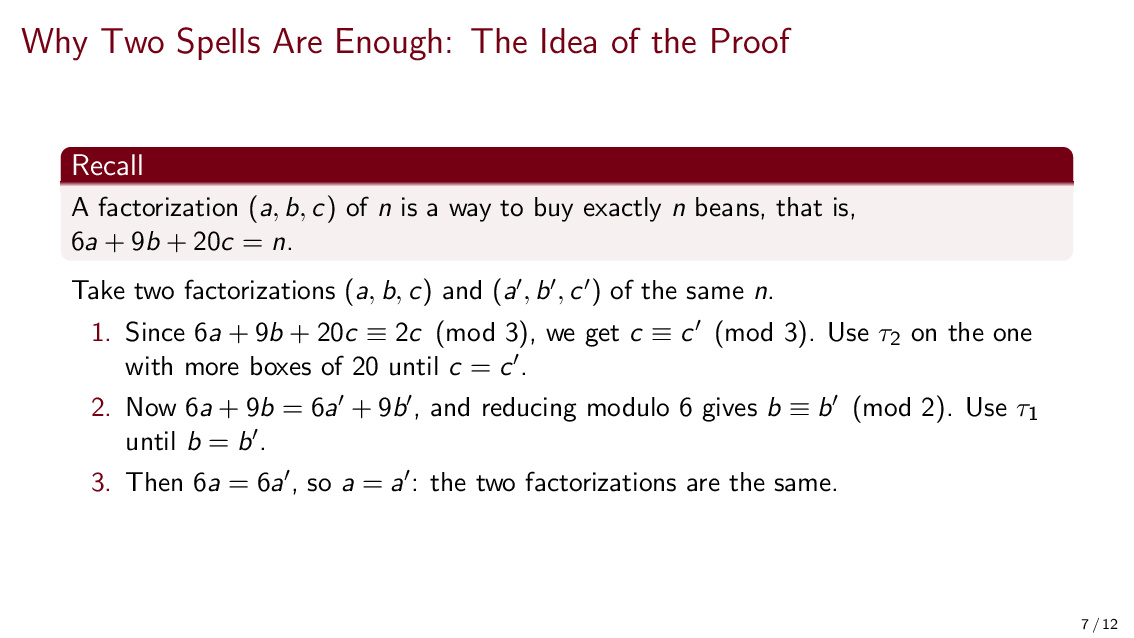
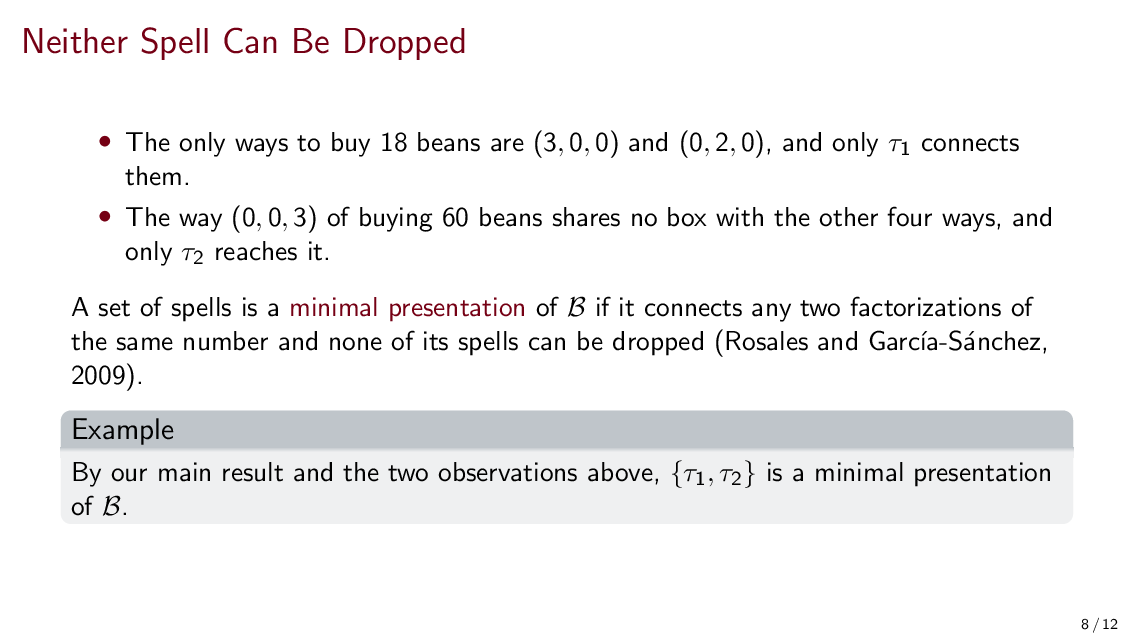
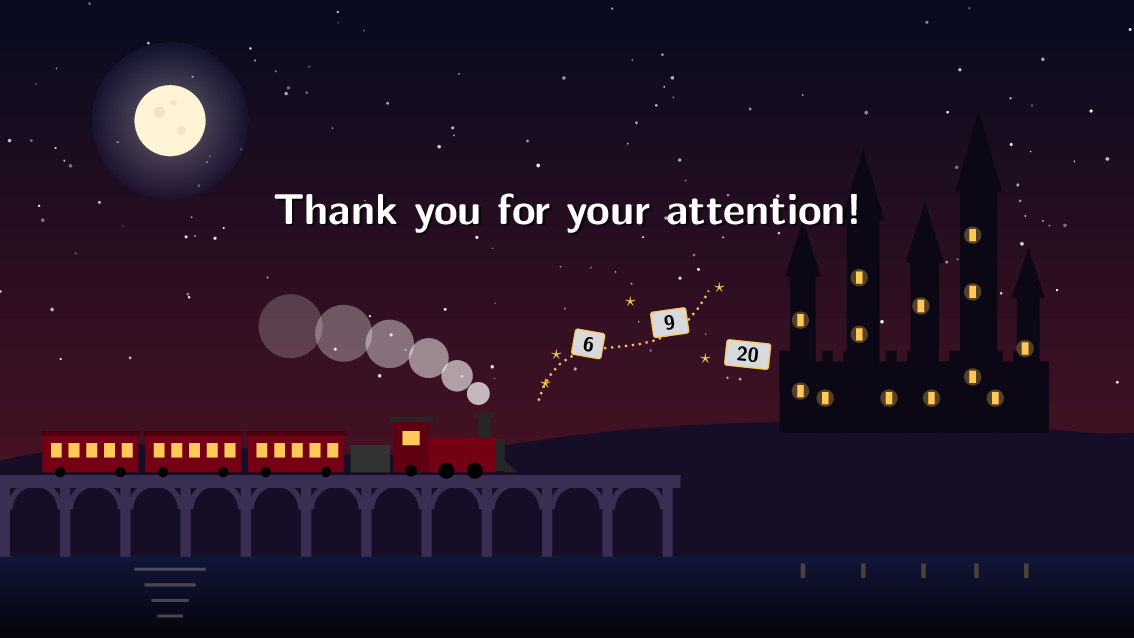
Notice that the talk starts with a question instead of a definition, that every definition is followed by an example, that the slides use a picture, a table, and a diagram, that the main result has a name instead of a number, that the only proof is short and teaches something, and that the talk ends with acknowledgments, a few references, and a last slide that thanks the audience for their attention.
Below, the LaTeX source is on the left and the slides are on the right. Scroll each side to read along. You can also download the slides (PDF), in the version without pauses that is ready to be posted online, and the LaTeX source. The source uses only standard packages and compiles with pdflatex, so you can start your own presentation from it.
% A sample Beamer presentation for young researchers (Felix Gotti, MIT PRIMES).
% For the version you post online, add "trans" to the class options:
%   \documentclass[trans,aspectratio=169]{beamer}
% The trans option ignores \pause and makes the slides easier to read.
\documentclass[aspectratio=169]{beamer}

\usepackage{amssymb}
\usepackage{booktabs}
\usepackage{tikz}
\usetikzlibrary{positioning}

% ---- Look: MIT colors, no navigation bar, numbered slides ----------------
\definecolor{mitred}{HTML}{750014}
\definecolor{mitsilver}{HTML}{8B959E}
\setbeamercolor{structure}{fg=mitred}
\setbeamercolor{alerted text}{fg=mitred}
\setbeamercolor{block title}{fg=white,bg=mitred}
\setbeamercolor{block body}{bg=mitred!6}
\setbeamercolor{block title example}{fg=black,bg=mitsilver!55}
\setbeamercolor{block body example}{bg=mitsilver!14}
\setbeamertemplate{blocks}[rounded][shadow=false]
\setbeamertemplate{navigation symbols}{}
\setbeamertemplate{footline}[frame number]
\setbeamertemplate{itemize items}[circle]

\newcommand{\nn}{\mathbb{N}}
\newcommand{\B}{\mathcal{B}}

% ---- Title page: all authors (alphabetical), mentor, conference, date ----
\title{A Transfiguration Theorem:\\ Trading Boxes of Every Flavour Beans}
\author[Granger, Potter, and Weasley]{Hermione Granger, Harry Potter, and Ronald Weasley\\[3pt]
  {\small Mentor: Prof.\ Remus Lupin}}
\institute{Gryffindor Program\\ Hogwarts School of Witchcraft and Wizardry}
\date{\alert{Fall-Term Gryffindor Conference}\\ October 17, 2026}

\begin{document}

\begin{frame}
  \titlepage
\end{frame}

% ---- Start with the question, not with a definition ----------------------
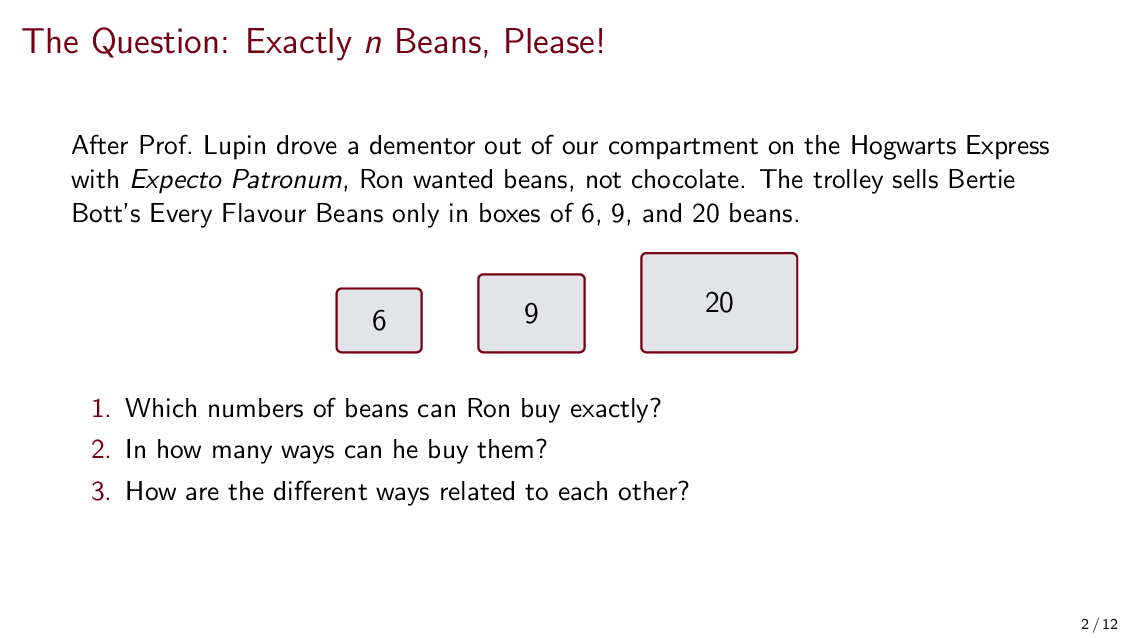
\begin{frame}{The Question: Exactly $n$ Beans, Please!}
  After Prof.\ Lupin drove a dementor out of our compartment on the Hogwarts
  Express with \emph{Expecto Patronum}, Ron wanted beans, not chocolate.
  The trolley sells Bertie Bott's Every Flavour Beans only in boxes of
  $6$, $9$, and $20$ beans.

  \begin{center}
  \begin{tikzpicture}[box/.style={draw=mitred,thick,fill=mitsilver!25,rounded corners=2pt}]
    \draw[box] (0,0) rectangle (1.2,0.9);   \node at (0.6,0.45) {\large $6$};
    \draw[box] (2.0,0) rectangle (3.5,1.1); \node at (2.75,0.55) {\large $9$};
    \draw[box] (4.3,0) rectangle (6.5,1.4); \node at (5.4,0.7) {\large $20$};
  \end{tikzpicture}
  \end{center}

  \begin{enumerate}
    \item Which numbers of beans can Ron buy exactly?
    \item In how many ways can he buy them?
    \item How are the different ways related to each other?
  \end{enumerate}
\end{frame}

% ---- Notation, and an example right after each definition ----------------
\begin{frame}{Notation and First Definitions}
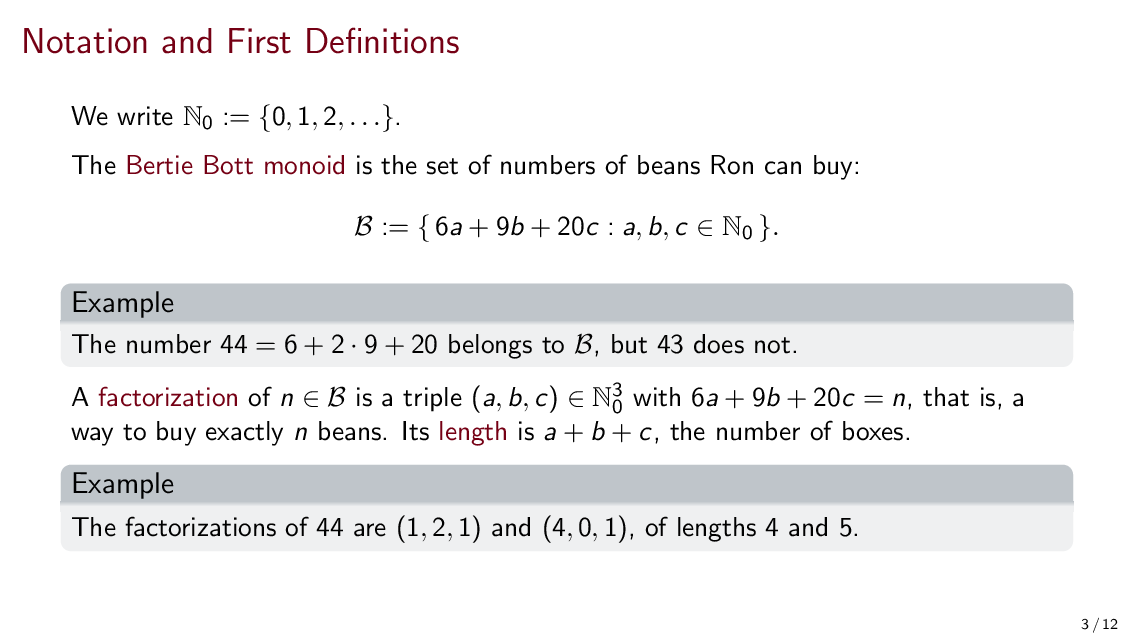
  We write $\nn_0 := \{0, 1, 2, \ldots\}$.

  \medskip
  The \alert{Bertie Bott monoid} is the set of numbers of beans Ron can buy:
  \[
    \B := \{\, 6a + 9b + 20c : a, b, c \in \nn_0 \,\}.
  \]
  \vspace{-1.2em}
  \begin{example}
    The number $44 = 6 + 2 \cdot 9 + 20$ belongs to $\B$, but $43$ does not.
  \end{example}

  A \alert{factorization} of $n \in \B$ is a triple $(a,b,c) \in \nn_0^3$ with
  $6a + 9b + 20c = n$, that is, a way to buy exactly $n$ beans. Its
  \alert{length} is $a + b + c$, the number of boxes.
  \begin{example}
    The factorizations of $44$ are $(1,2,1)$ and $(4,0,1)$, of lengths $4$ and $5$.
  \end{example}
\end{frame}

% ---- A picture is worth a thousand words ----------------------------------
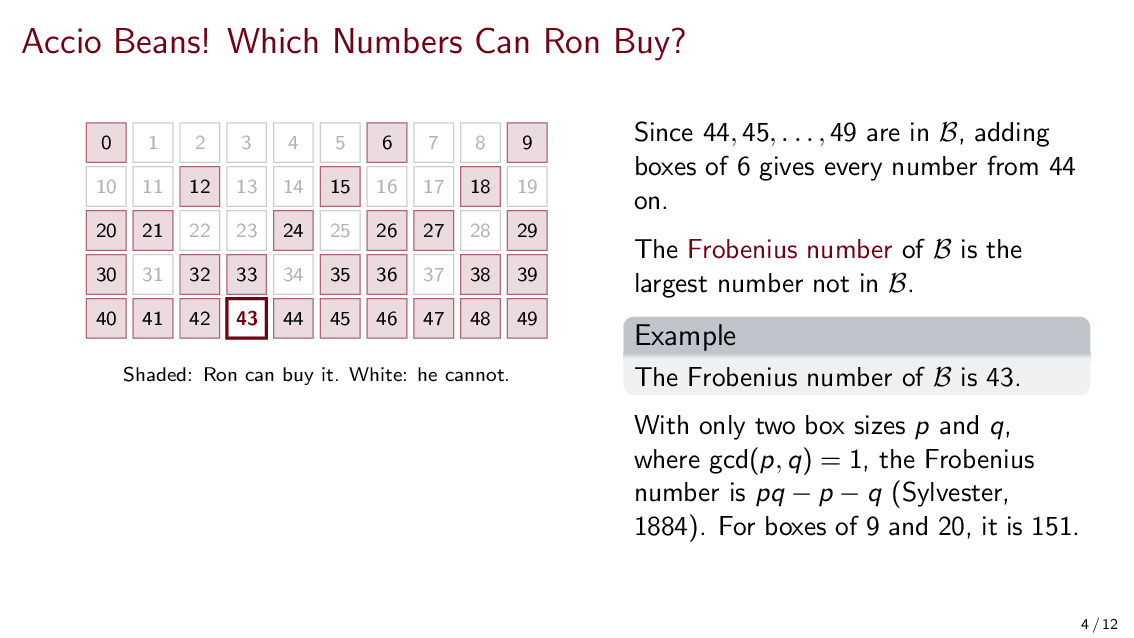
\begin{frame}{Accio Beans! Which Numbers Can Ron Buy?}
  \begin{columns}[T]
    \begin{column}{0.53\textwidth}
      \centering
      \begin{tikzpicture}[x=0.66cm,y=0.62cm,
          yes/.style={draw=mitred!60,fill=mitred!14,minimum size=0.56cm,inner sep=0pt,font=\scriptsize},
          no/.style={draw=gray!40,text=gray!60,minimum size=0.56cm,inner sep=0pt,font=\scriptsize}]
        \foreach \n in {0,6,9,12,15,18,20,21,24,26,27,29,30,32,33,35,36,38,39,40,41,42,44,45,46,47,48,49}
          \node[yes] at ({mod(\n,10)},{-floor(\n/10)}) {\n};
        \foreach \n in {1,2,3,4,5,7,8,10,11,13,14,16,17,19,22,23,25,28,31,34,37}
          \node[no] at ({mod(\n,10)},{-floor(\n/10)}) {\n};
        \node[no,draw=mitred,very thick,text=mitred] at (3,-4) {\textbf{43}};
      \end{tikzpicture}

      \smallskip
      {\scriptsize Shaded: Ron can buy it. White: he cannot.}
    \end{column}
    \begin{column}{0.45\textwidth}
      Since $44, 45, \ldots, 49$ are in $\B$, adding boxes of $6$ gives every
      number from $44$ on.

      \medskip
      The \alert{Frobenius number} of $\B$ is the largest number not in $\B$.
      \begin{example}
        The Frobenius number of $\B$ is $43$.
      \end{example}

      With only two box sizes $p$ and $q$, where $\gcd(p,q) = 1$, the
      Frobenius number is $pq - p - q$ (Sylvester, 1884). For boxes of $9$
      and $20$, it is $151$.
    \end{column}
  \end{columns}
\end{frame}

% ---- Tables organize examples ----------------------------------------------
\begin{frame}{Many Ways to Buy the Same Beans}
  The \alert{length set} of $n \in \B$ is the set $L(n)$ of lengths of all
  factorizations of $n$.

  \begin{center}
  \renewcommand{\arraystretch}{1.15}
  \begin{tabular}{rll}
    \toprule
    $n$ & factorizations $(a,b,c)$ & $L(n)$ \\
    \midrule
    $18$ & $(3,0,0),\ (0,2,0)$ & $\{2,3\}$ \\
    $36$ & $(6,0,0),\ (3,2,0),\ (0,4,0)$ & $\{4,5,6\}$ \\
    $44$ & $(4,0,1),\ (1,2,1)$ & $\{4,5\}$ \\
    $60$ & $(10,0,0),\ (7,2,0),\ (4,4,0),\ (1,6,0),\ (0,0,3)$ & $\{3,7,8,9,10\}$ \\
    \bottomrule
  \end{tabular}
  \end{center}

  \begin{example}
    The length set of $60$ is $L(60) = \{3,7,8,9,10\}$: Hermione buys $60$
    beans in $3$ boxes, while Ron, who likes opening boxes, buys them in $10$.
  \end{example}
\end{frame}

% ---- The main result: give it a name, not a number -----------------------
\begin{frame}{Our Main Result: Two Spells Are Enough}
  Consider the following two \alert{transfiguration spells}:
  \begin{itemize}
    \item[$\tau_1$:] three boxes of $6$ $\longleftrightarrow$ two boxes of $9$ \quad (both hold $18$ beans),
    \item[$\tau_2$:] three boxes of $20$ $\longleftrightarrow$ ten boxes of $6$ \quad (both hold $60$ beans).
  \end{itemize}

  \begin{theorem}[Granger, Potter, and Weasley, 2026]
    Any two ways of buying the same number of beans can be transfigured
    into each other using only $\tau_1$ and $\tau_2$.
  \end{theorem}

  \begin{example}
    \centering
    \begin{tikzpicture}[f/.style={draw=mitred,fill=white,rounded corners=2pt,inner sep=3pt,font=\small},
                        ->,>=stealth,thick,node distance=1.05cm]
      \node[f] (z1) {$(0,0,3)$};
      \node[f,right=of z1] (z2) {$(10,0,0)$};
      \node[f,right=of z2] (z3) {$(7,2,0)$};
      \node[f,right=of z3] (z4) {$(4,4,0)$};
      \node[f,right=of z4] (z5) {$(1,6,0)$};
      \draw (z1) -- node[above,font=\scriptsize] {$\tau_2$} (z2);
      \draw (z2) -- node[above,font=\scriptsize] {$\tau_1$} (z3);
      \draw (z3) -- node[above,font=\scriptsize] {$\tau_1$} (z4);
      \draw (z4) -- node[above,font=\scriptsize] {$\tau_1$} (z5);
    \end{tikzpicture}

    \smallskip
    All five factorizations of $60$ are connected by our two spells.
  \end{example}
\end{frame}

% ---- A proof only if it is short and teaches something --------------------
\begin{frame}{Why Two Spells Are Enough: The Idea of the Proof}
  \begin{block}{Recall}
    A factorization $(a,b,c)$ of $n$ is a way to buy exactly $n$ beans,
    that is, $6a + 9b + 20c = n$.
  \end{block}

  Take two factorizations $(a,b,c)$ and $(a',b',c')$ of the same $n$.
  \begin{enumerate}
    \item Since $6a + 9b + 20c \equiv 2c \pmod 3$, we get $c \equiv c' \pmod 3$.
      Use $\tau_2$ on the one with more boxes of $20$ until $c = c'$.
      \pause
    \item Now $6a + 9b = 6a' + 9b'$, and reducing modulo $6$ gives
      $b \equiv b' \pmod 2$. Use $\tau_1$ until $b = b'$.
      \pause
    \item Then $6a = 6a'$, so $a = a'$: the two factorizations are the same.
  \end{enumerate}
\end{frame}

% ---- Recall what the audience needs: they cannot turn back -----------------
\begin{frame}{Neither Spell Can Be Dropped}
  \begin{itemize}
    \item The only ways to buy $18$ beans are $(3,0,0)$ and $(0,2,0)$, and
      only $\tau_1$ connects them.
    \item The way $(0,0,3)$ of buying $60$ beans shares no box with the other
      four ways, and only $\tau_2$ reaches it.
  \end{itemize}

  \medskip
  A set of spells is a \alert{minimal presentation} of $\B$ if it connects
  any two factorizations of the same number and none of its spells can be
  dropped (Rosales and Garc\'{\i}a-S\'anchez, 2009).
  \begin{example}
    By our main result and the two observations above, $\{\tau_1, \tau_2\}$ is
    a minimal presentation of $\B$.
  \end{example}
\end{frame}

% ---- Finish by answering the questions you asked at the beginning ---------
\begin{frame}{Back to Ron's Three Questions}
  \begin{enumerate}
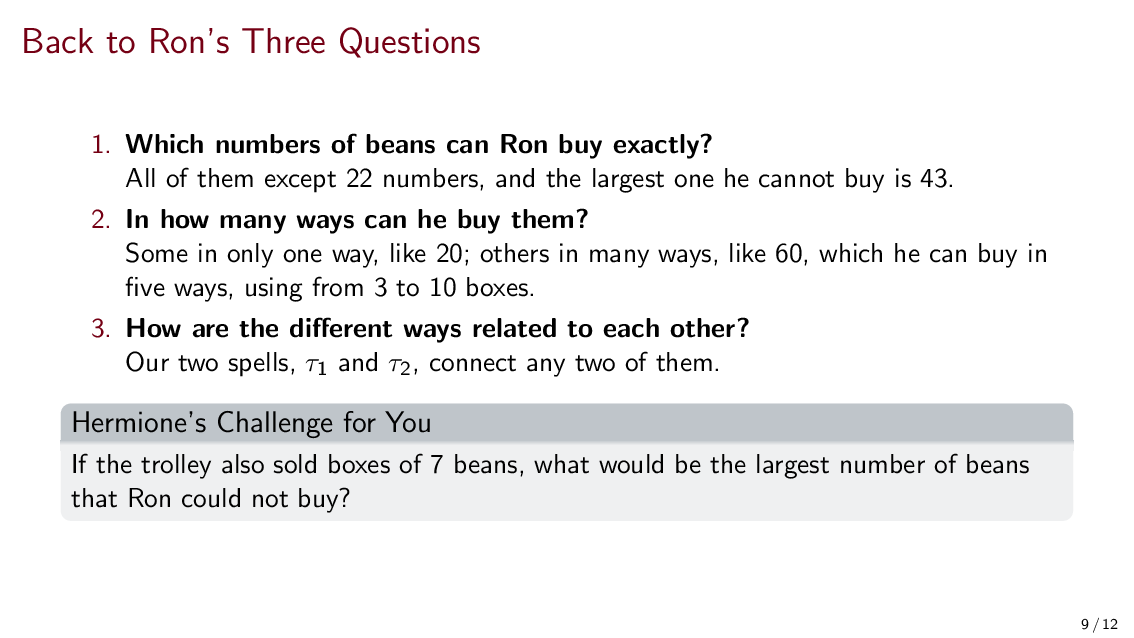
    \item \textbf{Which numbers of beans can Ron buy exactly?}\\
      All of them except $22$ numbers, and the largest one he cannot buy is $43$.
    \item \textbf{In how many ways can he buy them?}\\
      Some in only one way, like $20$; others in many ways, like $60$, which he
      can buy in five ways, using from $3$ to $10$ boxes.
    \item \textbf{How are the different ways related to each other?}\\
      Our two spells, $\tau_1$ and $\tau_2$, connect any two of them.
  \end{enumerate}

  \begin{exampleblock}{Hermione's Challenge for You}
    If the trolley also sold boxes of $7$ beans, what would be the largest
    number of beans that Ron could not buy?
    % Answer for the curious reader of this source: 17.
  \end{exampleblock}
\end{frame}

% ---- Thank the people who made the research possible -----------------------
\begin{frame}{Acknowledgments}
  \begin{itemize}
    \item We are grateful to our mentor, Prof.\ Remus Lupin, for his guidance
      throughout this project (and for the chocolate).
    \item We thank Prof.\ Minerva McGonagall for teaching us Transfiguration
      and for comments that improved our main result.
    \item We thank Rubeus Hagrid and Buckbeak the Hippogriff for testing
      every flavour, and Hedwig for delivering our drafts on time.
    \item Finally, we thank the organizers of the Gryffindor Program for making
      this magical research opportunity possible.
  \end{itemize}
\end{frame}

% ---- Only the main references, as further reading --------------------------
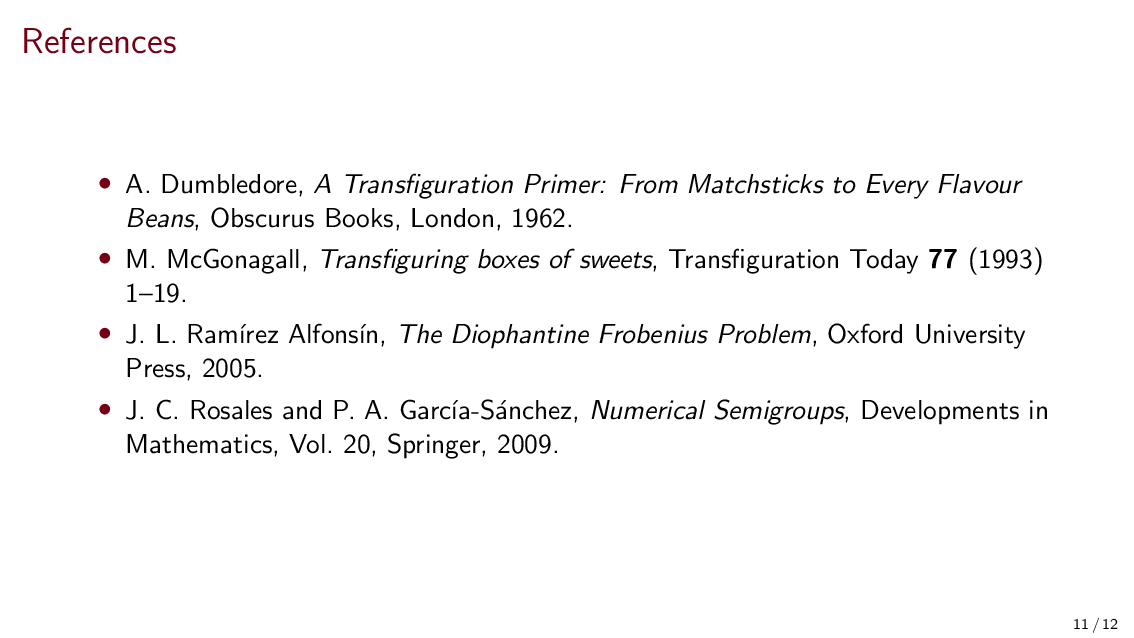
\begin{frame}{References}
  \begin{itemize}
    \item A. Dumbledore, \emph{A Transfiguration Primer: From Matchsticks to
      Every Flavour Beans}, Obscurus Books, London, 1962.
    \item M. McGonagall, \emph{Transfiguring boxes of sweets},
      Transfiguration Today \textbf{77} (1993) 1--19.
    \item J. L. Ram\'{\i}rez Alfons\'{\i}n, \emph{The Diophantine Frobenius
      Problem}, Oxford University Press, 2005.
    \item J. C. Rosales and P. A. Garc\'{\i}a-S\'anchez, \emph{Numerical
      Semigroups}, Developments in Mathematics, Vol.~20, Springer, 2009.
  \end{itemize}
\end{frame}

% ---- Thank your audience: they gave you their time and attention ----------
% The picture is drawn with TikZ, so the file needs no image files.
\definecolor{nightsky}{HTML}{070B1F}
\definecolor{dusk}{HTML}{1C1F4A}
\definecolor{horizon}{HTML}{5E1426}
\definecolor{hills}{HTML}{150E26}
\definecolor{castle}{HTML}{0B0714}
\definecolor{stone}{HTML}{3A2E52}
\definecolor{lakeTop}{HTML}{121638}
\definecolor{lakeBottom}{HTML}{04050D}
\definecolor{windowgold}{HTML}{FFC857}
\definecolor{moon}{HTML}{FFF4D6}
\begin{frame}[plain]
  \begin{tikzpicture}[remember picture, overlay]
    \begin{scope}[shift={(current page.south west)}, x=1cm, y=1cm]
      % Night sky with stars and the moon
      \shade[top color=nightsky, middle color=dusk, bottom color=horizon] (0,0) rectangle (16,9);
      \pgfmathsetseed{2026}
      \foreach \i in {1,...,140} {
        \pgfmathsetmacro{\sx}{16*rnd}
        \pgfmathsetmacro{\sy}{3.6+5.4*rnd}
        \pgfmathsetmacro{\sr}{0.006+0.018*rnd}
        \pgfmathsetmacro{\so}{0.35+0.65*rnd}
        \fill[white, opacity=\so] (\sx,\sy) circle (\sr);
      }
      \shade[inner color=white, outer color=dusk, opacity=0.35] (2.4,7.3) circle (1.1);
      \fill[moon] (2.4,7.3) circle (0.5);
      \fill[moon!75!gray, opacity=0.5] (2.25,7.42) circle (0.08) (2.56,7.16) circle (0.06) (2.45,7.55) circle (0.04);

      % Hills and the lake
      \fill[hills] (0,1.1) -- (0,2.5) .. controls (2.5,3.1) and (4.5,2.3) .. (7,2.7)
        .. controls (9.5,3.1) and (10.5,3.0) .. (12.5,3.1) .. controls (14,3.2) and (15,2.8) .. (16,2.9)
        -- (16,1.1) -- cycle;
      \shade[top color=lakeTop, bottom color=lakeBottom] (0,0) rectangle (16,1.15);
      \foreach \i/\w in {0/0.5, 1/0.36, 2/0.26, 3/0.18}
        \fill[moon, opacity=0.25] (2.4-\w,0.95-0.22*\i) rectangle (2.4+\w,0.99-0.22*\i);
      \foreach \x in {11.3, 12.15, 13.0, 13.75, 14.45}
        \fill[windowgold, opacity=0.25] (\x,0.85) rectangle (\x+0.06,1.05);

      % Hogwarts castle with lit windows
      \fill[castle] (11.0,2.9) rectangle (14.8,3.9);
      \foreach \x in {11.0,11.3,...,14.6}
        \fill[castle] (\x,3.9) rectangle (\x+0.15,4.05);
      \foreach \x/\w/\h/\r in {11.15/0.36/5.1/0.8, 11.95/0.46/5.9/1.0, 12.85/0.40/5.3/0.85,
                               13.55/0.52/6.3/1.15, 14.35/0.32/4.8/0.7} {
        \fill[castle] (\x,2.9) rectangle (\x+\w,\h);
        \fill[castle] (\x-0.07,\h) -- (\x+\w/2,\h+\r) -- (\x+\w+0.07,\h) -- cycle;
      }
      \foreach \x/\y in {11.25/4.4, 11.25/3.4, 12.08/5.0, 12.08/4.2, 12.95/4.6, 13.68/5.6,
                         13.68/4.8, 13.68/3.6, 14.42/4.0, 11.6/3.3, 12.5/3.3, 13.1/3.3, 14.0/3.3} {
        \fill[windowgold, opacity=0.3] (\x+0.045,\y+0.085) circle (0.12);
        \fill[windowgold] (\x,\y) rectangle (\x+0.09,\y+0.17);
      }

      % The viaduct and the Hogwarts Express
      \fill[stone] (-0.1,2.12) rectangle (9.6,2.3);
      \foreach \i in {0,...,10} {
        \pgfmathsetmacro{\x}{0.85*\i}
        \fill[stone] (\x,1.15) rectangle (\x+0.14,2.12);
        \draw[stone, line width=2.2pt] (\x+0.14,1.82) arc (180:0:0.355);
      }
      \fill[stone] (9.35,1.15) rectangle (9.49,2.12);
      \foreach \x in {0.6, 2.05, 3.5} {
        \fill[mitred] (\x,2.34) rectangle (\x+1.35,2.86);
        \fill[mitred!60!black] (\x-0.02,2.86) rectangle (\x+1.37,2.92);
        \foreach \k in {0,...,4}
          \fill[windowgold] (\x+0.12+0.25*\k,2.55) rectangle (\x+0.27+0.25*\k,2.75);
        \fill[black] (\x+0.25,2.34) circle (0.07) (\x+1.1,2.34) circle (0.07);
      }
      \fill[black!80] (4.95,2.34) rectangle (5.5,2.72);
      \fill[mitred!80!black] (5.55,2.34) rectangle (6.05,3.05);
      \fill[black!85] (5.5,3.05) rectangle (6.1,3.12);
      \fill[windowgold] (5.68,2.72) rectangle (5.92,2.92);
      \fill[mitred] (6.05,2.34) rectangle (7.0,2.82);
      \fill[black!85] (7.0,2.36) rectangle (7.12,2.8);
      \fill[black!85] (6.75,2.82) rectangle (6.92,3.12) (6.7,3.12) rectangle (6.97,3.18);
      \fill[black!85] (7.12,2.34) -- (7.3,2.34) -- (7.12,2.5) -- cycle;
      \fill[black] (6.3,2.36) circle (0.11) (6.7,2.36) circle (0.11) (5.8,2.36) circle (0.08);
      \foreach \x/\y/\r/\o in {6.75/3.45/0.16/0.7, 6.45/3.7/0.22/0.6, 6.05/3.95/0.28/0.5,
                               5.5/4.15/0.34/0.4, 4.85/4.3/0.4/0.3, 4.1/4.4/0.45/0.2}
        \fill[white, opacity=\o] (\x,\y) circle (\r);

      % Three boxes of beans, floating (Wingardium Leviosa!)
      \draw[windowgold, dotted, line width=0.8pt] (7.6,3.35) .. controls (8.0,4.7) and (9.3,3.5) .. (10.0,4.9);
      \foreach \x/\y/\a/\w/\n in {8.3/4.15/-10/0.42/6, 9.45/4.45/8/0.5/9, 10.55/4.0/-6/0.62/20}
        \node[draw=windowgold, fill=mitsilver!35, rotate=\a, minimum width=\w cm, minimum height=0.36cm,
              inner sep=1pt, rounded corners=1pt, font=\scriptsize\bfseries] at (\x,\y) {\n};
      \foreach \x/\y in {7.85/4.0, 8.9/4.75, 9.95/3.95, 10.15/4.95, 7.7/3.6}
        \node[text=windowgold, font=\scriptsize] at (\x,\y) {$\star$};

      % The message
      \node[text=black, opacity=0.5, font=\LARGE\bfseries] at (8.04,5.96) {Thank you for your attention!};
      \node[text=white, font=\LARGE\bfseries] at (8,6.0) {Thank you for your attention!};
    \end{scope}
  \end{tikzpicture}
\end{frame}

\end{document}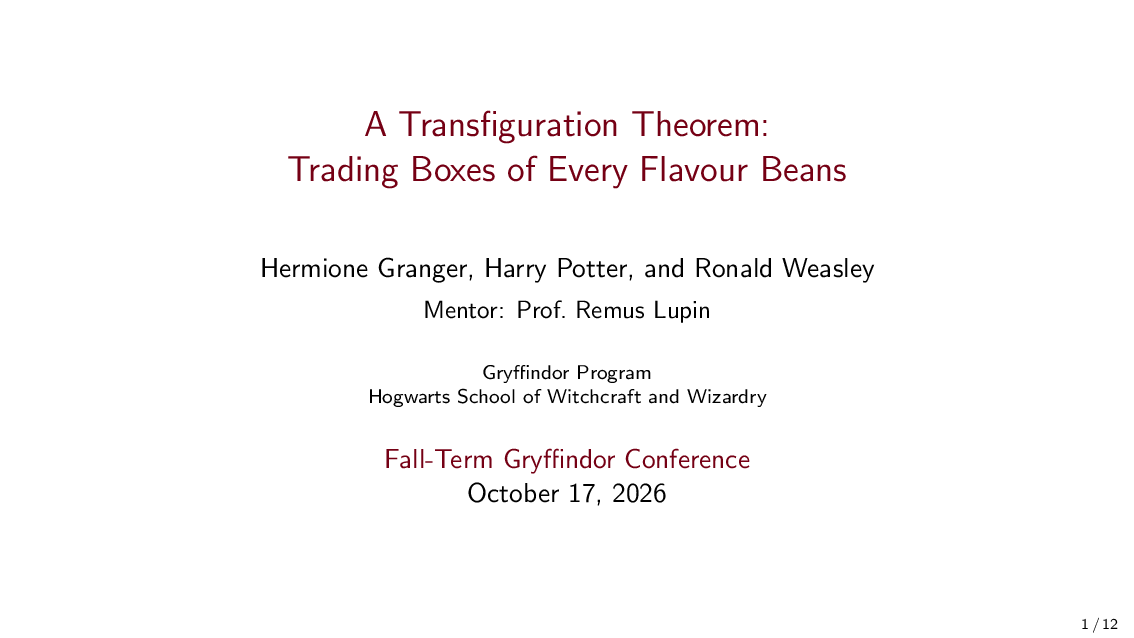

Recommended Reading
- Nicholas J. Higham, Handbook of Writing for the Mathematical Sciences, third edition, SIAM, 2020, Chapters 12 (“Writing a Talk”) and 13 (“Giving a Talk”) (my favorite).
- Terence Tao, Talks are not the same as papers.
- Gian-Carlo Rota, Ten lessons I wish I had been taught, Notices of the AMS 44 (1997), 22–25.
- Paul R. Halmos, How to talk mathematics, Notices of the AMS 21 (1974), 155–158.
- Philip E. Bourne, Ten simple rules for making good oral presentations, PLOS Computational Biology 3 (2007), e77.
- Till Tantau, Joseph Wright, and Vedran Miletić, The beamer class, user guide, Section 5, “Guidelines for Creating Presentations”.
- MAA Mathematical Communication, Presentations, a collection of resources that started in the MIT Department of Mathematics.