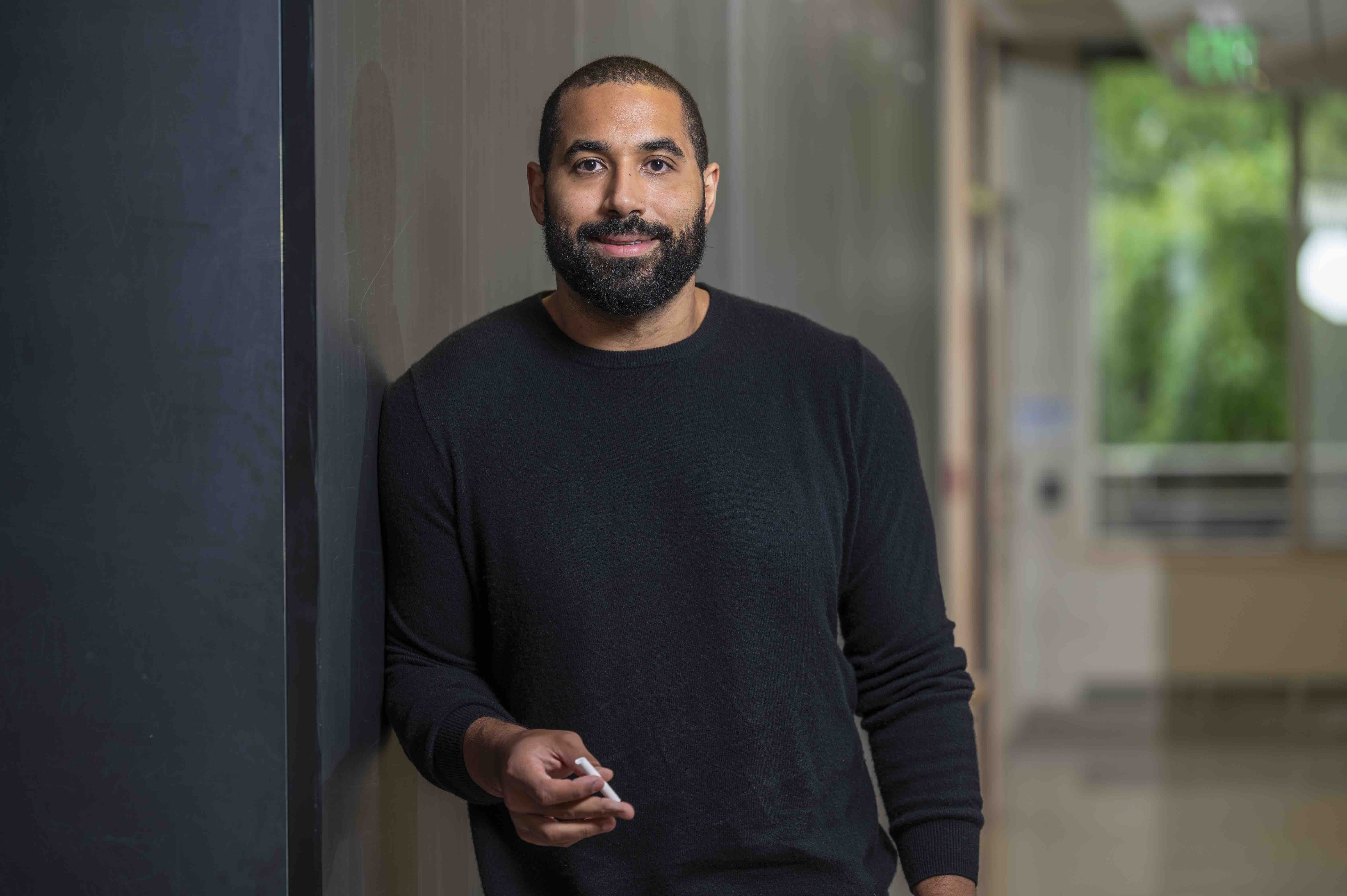
John Urschel
Class of 1956 Career Development
Assistant Professor
MIT Department of Mathematics
urschel AT mit DOT edu
I am an Assistant Professor at MIT Math. Before that, I was a Junior Fellow at the Harvard Society of Fellows and a Member of the Institute for Advanced Study. I did my PhD at MIT Math.
My research is focused on applied linear algebra, broadly defined. This includes topics like matrix analysis, numerical linear algebra, random matrix theory, spectral graph theory, etc.
I am particularly interested in direct methods for linear systems, discrete nodal statistics,
extremal eigenvalue problems, Krylov subspace/moment problems, and matrix recovery/recognition problems.
Here are a some of my favorite papers:
I am grateful for support from the National Science Foundation, through DMS-2513687
(and DMS-2218846 and DMS-2522789, for the MIT PRIMES program).
Here are some honors I've received: SIAM DiPrima Prize, SIAM Linear Algebra Early Career Prize, ILAS Brualdi Prize, Dartmouth College Doctor of Letters, Penn State Distinguished Alumni Award
Below you'll find what I am teaching/what I have taught, a list of my students, all my papers, and some outreach I do these days.
Here’s a (most likely outdated) CV.
Teaching:
- 18.S995: Matrix Analysis & Computations, MIT, Sp. '26
- 18.06: Linear Algebra, MIT, Fall '25
- 18.335: Introduction to Numerical Methods, MIT, Sp. '24
- 18.330: Introduction to Numerical Analysis, MIT, Fall '23
- Math 232: Integral Vector Calculus, Penn State, Fall '13
- Math 041: Trigonometry and Analytic Geometry, Penn State, Sp. '13
Students:
Postdocs: Rikhav Shah
PhD Students: Aaron Moser, Genaro Laymuns, Nicholas West
Undergraduates: Hypatia Hamkins, Susie Lu, Samuel Orellana Mateo, Elsa Frankel, Keming Zhou (Copenhagen math PhD), George Shaker (Greenflash), Ankit Bisain (Princeton math PhD), Cecilia Chen (Berkeley math PhD), Rachana Madakura (MIT CS PhD), Matthew Cho (UCSD math PhD), Enrico Colón (Harvard math PhD)
Papers / Preprints / Theses:
-
Entry Growth in Gaussian Elimination
with R. Shah. arXiv, 2026.
-
On the Exponential Rate of the Condition Number of Fourier Submatrices and Vandermonde Matrices
with R. Shah. arXiv, 2026.
-
LU Factorization of Discrete Random Matrices
with S.O. Mateo, N. West. arXiv, 2026.
-
Spectral Density Estimation for Normal Matrices
with C. Musco, C. Musco, R. Shah, N. West. arXiv, 2026.
-
A Class of Optimal Directed Graphs for Network Syncronization
with J. Liu, S. Lu. arXiv, 2026.
-
What is Jackson's Constant?
with R. Shah, N. West. Applied Math Letters, 2026.
-
The Largest 5th Pivot may be the Root of a 61st Degree Polynomial
with J. Chen, A Edelman. IMA Journal of Numerical Analysis, 2026.
-
Numerical Stability in Gaussian Elimination
Notices of the AMS, 2025.
-
Nodal Count for Orthogonally Invariant Ensembles
with L. Alon, D. Mikulincer. arXiv, 2025.
- A New Upper Bound for the Growth Factor in Gaussian Elimination with Complete Pivoting
with A. Bisain, A. Edelman. Bulletin of the LMS, 2025.
- Estimating the Matrix p -> q Norm
with L. Guth, D. Maldague. SIAM Journal on Matrix Analysis, 2025.
- On the Maximum Spread of Non-Negative Matrices
with S. Lu. Linear Algebra and its Applications, 2025.
- On the Frobenius Norm of the Inverse of a Non-Negative Matrix
with E. Frankel. Linear Algebra and its Applications, 2025.
- Estimating the Numerical Range with a Krylov Subspace
with C. Chen. arXiv, 2024.
- Average Nodal Count and the Nodal Count Condition for Graphs
with L. Alon. arXiv, 2024.
- Nodal Decompositions of a Symmetric Matrix
with T. McKenzie. International Math Research Notices, 2024.
- Some New Results on the Maximum Growth Factor in Gaussian Elimination
with A. Edelman. SIAM Journal on Matrix Analysis, 2024.
- Recovering a Magnitude-Symmetric Matrix from its Principal Minors
with VE. Brunel. Linear Algebra and its Applications, 2024.
- Hamilton Powers of Eulerian Digraphs
with E. Colón. Electronic Journal of Combinatorics, 2024.
- On a Perturbation Analysis of Higham Squared Maximum Gaussian Elimination Growth Matrices
with A. Edelman, B. Zhu. arXiv Technical Report, 2024. (see Bowen's associated thesis here)
- Representing the Special Linear Group with Block Unitriangular Matrices
PNAS Nexus, 2023.
- Maximum Spread of Graphs and Bipartite Graphs
with J. Breen, A. Riasanovsky, M. Tait. Communications of the AMS, 2022.
- Graphs, Principal Minors, and Eigenvalue Problems
PhD Thesis, MIT, 2021.
- Multidimensional Scaling: Approximation and Complexity
with E. Demaine, A. Hesterberg, F. Koehler, J. Lynch. ICML 2021.
- Uniform Error Estimates for the Lanczos Method
SIAM Journal on Matrix Analysis, 2021.
- Regarding Two Conjectures on Clique and Biclique Partitions
with D. Rohatgi, J. Wellens. Electronic Journal of Combinatorics, 2021.
- Discrete Trace Theorems and Energy Minimizing Spring Embeddings of Planar Graphs
with L. Zikatanov. Linear Algebra and its Applications, 2021.
- Testing Gap k-Planarity is NP-Complete
with J. Wellens. Information Processing Letters, 2021.
- Nodal Decompositions of Graphs
Linear Algebra and its Applications, 2018.
- Maximum Likelihood Estimation of Determinantal Point Processes
with VE. Brunel, A. Moitra, P. Rigollet. arXiv Technical Report, 2017.
- On the Characterization and Uniqueness of Centroidal Voronoi Tessellations
SIAM Journal on Numerical Analysis, 2017.
- Learning Determinantal Point Processes with Moments and Cycles
with VE. Brunel, A. Moitra, P. Rigollet. ICML 2017.
- Rates of Estimation for Determinantal Point Processes
with VE. Brunel, A. Moitra, P. Rigollet. COLT 2017.
- On the Approximation of Laplacian Eigenvalues in Graph Disaggregation
with X. Hu, L. Zikatanov. Linear and Multilinear Algebra, 2017.
- On the Maximal Error of Spectral Approximation of Graph Bisection
with L. Zikatanov. Linear and Multilinear Algebra, 2016.
- A Cascadic Multigrid Algorithm for Computing the Fiedler Vector of Graph Laplacians
with X. Hu, J. Xu, L. Zikatanov. Journal of Computational Mathematics, 2015.
- Spectral Bisection of Graphs and Connectedness
with L. Zikatanov. Linear Algebra and its Applications, 2014.
- Graph-Based Topics in Applied Mathematics
Master's Thesis, Penn State, 2013.
- A Space-Time Multigrid Method for the Numerical Valuation of Barrier Options
Communications in Mathematical Finance, 2013.
- Instabilities in the Sun-Jupiter-Asteroid Three Body Problem
with J. Galante. Celestial Mechanics and Dynamical Astronomy, 2013.
Outreach:
Here are a few programs outside of my core responsibilities as an academic mathematician that I take part in. If you are a K-12 math teacher or student, some of these programs may be of interest to you.
MathROOTS: MathROOTS is a two-week summer program hosted by MIT Math for high-potential high school students from underserved communities. I am the Menezes Challenge Lecturer for the program, and was previously the academic coordinator for a number of years. More details can be found here.
Mathical: The Mathical Book Prize, awarded by SLMath/MSRI, is an annual award for books that inspire children of all ages to see math in the world around them. I am on the selection committee, previously served a four year term as a committee chair, and help a bit with their readathons. More details can be found here.
MoMath: The National Museum of Mathematics highlights the role of math in illuminating the patterns and structures all around us. I serve on the board of the museum and am involved in the exhibits and programming of the museum. More details can be found here.
© 2020 John Urschel -- template shamelessly stolen from Tselil Schramm.
Accessibility