


All questions will be worth 5 points. With very brief answers!
 over
over
 and are both integrable and have the same integral. Thus the
difference is integrable over
and are both integrable and have the same integral. Thus the
difference is integrable over  with zero integral. Since it is a
non-negative function it must vanish except possibly on a set of measure
zero. Thus the upper and lower integrals of
with zero integral. Since it is a
non-negative function it must vanish except possibly on a set of measure
zero. Thus the upper and lower integrals of  over must be equal
off a set of measure zero.
over must be equal
off a set of measure zero.
(a) Now, by definition,
 (excuse my notation for the
boundary). So if
(excuse my notation for the
boundary). So if  is in the interior of
  it is not in
  so
so
 nearby is continuous. If is in the interior of the complement
then
nearby is continuous. If is in the interior of the complement
then  is locally zero, hence again continuous at
  Thus we can
suppose that
Thus we can
suppose that
 Since
Since
 is continuous as
a function on nearby. On the otherhand since
is continuous as
a function on nearby. On the otherhand since
 the limit at
in is zero, hence the limit at along all sequences is
the limit at
in is zero, hence the limit at along all sequences is  hence is continuous at
(b) Here is the hair-splitting! If is continuous at the
since it is discontinuous even from there. On the other
hand
 since if
 then it is a
non-isolated boundary point at which the limit of from either fails
to exist of is non-zero; either way cannot be continuous there.
then it is a
non-isolated boundary point at which the limit of from either fails
to exist of is non-zero; either way cannot be continuous there.
(c) Each point  is a point in which is isolated, so is at a
positive distance from
is a point in which is isolated, so is at a
positive distance from
 Hence
Hence  is discrete in the
sense that each point of is positive distance from the rest of
is discrete in the
sense that each point of is positive distance from the rest of  Since is bounded, such a set is countable, there being only a finite
number of points distant at least
Since is bounded, such a set is countable, there being only a finite
number of points distant at least  from the others, for each
(d) So if and  have measure zero, then is integrable by
(a). If is integrable on
have measure zero, then is integrable by
(a). If is integrable on  i.e. is integrable, then by (b)
 has measure zero. Thus and
 have
measure zero, but by (c) is countable, so this is equivalent to the
condition that both and have measure zero.
have
measure zero, but by (c) is countable, so this is equivalent to the
condition that both and have measure zero.
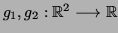 be continuously differentiable and suppose
 Let
Let
 |
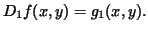 By the Fundamental Theorem of Calculus,
![$\displaystyle D_1f(x,y)=g_1(x,0)+\int_0^yD_1g_2(x,t)dt= g_1(x,0)+\int_0^yD_2g_1(x,t)dt=g_1(x,0)+\big[g_2(x,t)\big]_0^y=g_2(x,y).$](img32.png) |
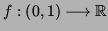 is a non-negative continuous function. Show that
  exists if and only if
 exists.
(b)