


Part I: (10 pts)
Lecture 22. (Thurs. April 1): Differentials, exactness. Criterion for conservative fields; finding potential functions. Read: Notes pp. 2.1-2.5 (p. 2.6 is optional--it is covered in 18.03). EP pp. 980-982 covers about the same material; if you read the book, be sure to read the Notes p. 2.1 for the proof of the theorem, which the book omits. Problems: Work: Notes 2.7 5a (use method 1 of notes), 5b (use method 2), 6ab (do it using both methods) (S. 28)
If
 , then
 is called the (mathematical)
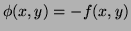
potential function. The physical potential function is given by
 , so in physics classes the relation is written
 .
Lecture 23. (Fri. April 2): Green's Theorem. Read EP, pp. 986-989. Probs: Notes: SP.4/4-C1, a, b, c, SP.5/4-C2, 3, 4, 5 (S.30)
Lecture 24. (Tues. April 6): Two-dimensional flux. Normal form of Green's Theorem. Read: Notes secs. 3 and 4; EP pp. 989-992 is similar, but more condensed; the normal form is called the ``vector form'' of Green's theorem. Probs: Notes: 3.4/lac,2 (give brief reason or draw picture) 3.4/3, 4, 5 (give a direct calculation; don't use Green) 4.5/4b (S. 31-33)
Lecture 25 (Thurs. April 8): Extensions and applications of Green's Theorem; topology in the plane. Read: Notes: 5 and 6.
Exam 3. (Fri. April 9) 2:05-2:55 in Walker. This will cover double integrals and line integrals through Lecture 24. (Lecture 25 will not be included.)
Part II
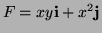 is not a gradient field.
Solution:
 so the criterion fails and
 cannot be a gradient.
 namely
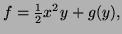 but then cannot solve
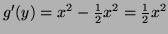 since this is not
a function of
 alone.
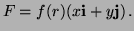
 .
 .
if
 .
Solution:

 (assuming the vector
field is continuous there) along a radius. Then
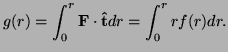 |
then
 by
integration by parts.
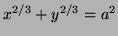 has the
parametrization

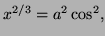
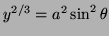 so
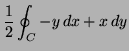
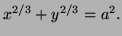 Here,

 |
 |
 |
|
|
 |
||
|
 |
||
|
 |
||
|
 |
||
|
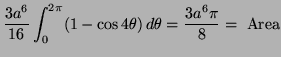 |
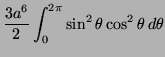
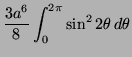
Find the closed curve  in the plane for which
 has the biggest value, and determine this
biggest value. (Use Green's theorem, and study the resulting
double integral - how would you make it biggest?)
Solution: By Green's theorem
 |
is the unit circle, value is

Find the flux of the vector field
 through the
square of side two with center at the origin and one vertex at
 .
Solution: With  this square and
its boundary,

is called harmonic if it
satisfies Laplace's equation:

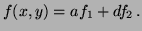
 can be written as a linear combination of two basic cubic
harmonic functions
 and
 , i.e., in the form

is harmonic, and
 , then the flux of
 through any closed curve is zero.
Solution:
 |
|||
 |
|||
 |
|||
 |
|||
 |
 |
These one should be saved for next week, they were not supposed to be on this problem set.
A regular solid has dimensions  . Its density is
 .
 .
(Place the solid so this edge lies along the
 -axis.)
 and
 .
About which edge will the moment of inertia be greatest?
Smallest? Predict the answer by physical intuition, then
verify it by using the formula you found in part (a).
Find the average distance of a point in a solid sphere of radius
from
Definition: The average value of  over
region
 in -space is

For (c), you have to choose whether to make the limits easy, but
the integrand hard, or to place the sphere so the integrand is
easy, but the limits harder. Do the latter: place the sphere so
the point is at the origin and the axis along the -axis; this
makes the integrand easy and the main issue is the equation of the sphere.